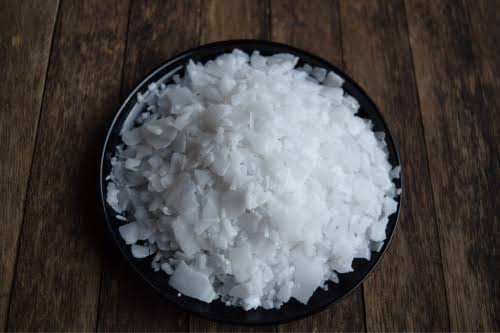

The detergent and hygiene industries are among the largest global consumers of alkaline compounds. Within this sector, sodium hydroxide—commercially known as caustic soda or in its solid form—plays an indispensable role across the production chain of cleaning products. A technical review of the application of caustic soda flakes in detergent production shows that this substance serves not only as a primary raw material in core processes such as soap making, but also as a key element for pH adjustment, neutralization of organic acids, and performance enhancement in industrial formulations.
Owing to its high water solubility and extreme alkalinity, caustic soda flakes are the preferred choice for detergent manufacturing plants when reacting with fats and sulfonic acids. As a cornerstone within the family of bases and alkalis, this chemical enables the rapid breakdown of grease stains and organic bonds. Understanding the thermodynamic and kinetic properties of this compound enables chemical engineers and formulators to produce more efficient and cost-effective cleaning agents.
Chemical Fundamentals of Caustic Soda Flakes in Detergent Formulations
Sodium hydroxide is an ionic compound composed of sodium cations and hydroxide anions, categorized among foundational inorganic chemicals. This strong base possesses an exceptional capability to deprotonate acidic molecules. Dissolving caustic soda flakes in water is an intensely exothermic reaction that yields a solution with very high pH. This alkaline environment provides the necessary medium for ester hydrolysis reactions.
In the hygiene and cleaning industries, the purity and consistency of caustic soda flakes directly impact the clarity and stability of the final product. Metallic impurities such as iron can cause discoloration or degrade the quality of saponified fatty acids. Consequently, suppliers must uphold stringent quality standards to prevent haziness in finished detergents. The capacity of caustic soda to break down lipid structures makes it an irreplaceable chemical in soap manufacturing.
The Saponification Process and Solid Soap Manufacturing
One of the most fundamental examples of caustic soda flake utilization in the detergent industry is the saponification reaction. In this process, triglycerides present in vegetable oils or animal fats react with aqueous caustic soda. The ester linkages are cleaved, releasing glycerol alongside sodium salts of fatty acids. These resultant sodium salts constitute traditional hard soap, providing the essential cleansing action.
The sodium cation in caustic soda promotes the formation of rigid crystalline lattices, yielding hard soaps. Conversely, employing potassium hydroxide yields soft and liquid soaps. Precise stoichiometric control of this reaction is critical, as residual unreacted caustic soda can cause chemical burns to human skin. The key stages of this manufacturing process include:
- Preparation and preheating of the lipid phase (vegetable oils or free fatty acids).
- Dissolution of caustic soda flakes in purified water to achieve a specific Baumé density.
- Gradual blending of the caustic solution into the oil phase under continuous agitation at controlled temperatures.
- Separation of glycerin, washing the soap curd, and adjusting final moisture levels prior to molding.
The Role of Caustic Soda Flakes in Synthetic Detergent Production
Modern synthetic detergents rely primarily on anionic, nonionic, and amphoteric surfactants rather than traditional soaps alone. In these formulations, caustic soda functions predominantly as a neutralizing agent. The core active ingredient in dishwashing liquids, hand soaps, and laundry powders is linear alkylbenzene sulfonic acid (LABSA). Classified among industrial organic chemicals, this surfactant requires complete neutralization to become functional.
Introducing sodium hydroxide to sulfonic acid yields sodium alkylbenzene sulfonate. This resulting salt is a high-performance anionic surfactant featuring superior foaming and detergency properties. The neutralization reaction must be monitored carefully to ensure a balanced, skin-friendly final pH. Uncontrolled temperature spikes during caustic addition can degrade both the color and clarity of the surfactant batch.
LABSA + NaOH → Sodium Alkylbenzene Sulfonate + H2O
pH Adjustment and Formulation Stability
Acidity control is a critical pillar in liquid cleaner formulation. Minor shifts in pH can compromise emulsion stability, alter product viscosity, and deactivate preservative systems. Formulators utilize diluted caustic soda solutions to elevate the formulation pH to its target range—typically between 6.5 and 8 in hand and dishwashing detergents. This neutralization step secures viscosity stability across both cold and warm operating seasons.
Accurate dosing of caustic soda also prevents the precipitation of secondary additives. Ingredients such as builders and chelating agents exhibit peak performance within narrow pH thresholds. By establishing the required chemical environment, caustic soda maximizes the efficacy of all complementary formula components.
Heavy-Duty Cleaners and Industrial Drain Openers
Beyond domestic products, heavy-duty industrial cleaners account for a substantial volume of caustic soda consumption. Specialized oven cleaners, automotive degreasers, and industrial drain openers incorporate high concentrations of caustic soda flakes. The protein structures of hair and hardened lipid deposits degrade rapidly when exposed to concentrated alkaline media. In these applications, sodium hydroxide acts as the primary active chemical to dissolve obstructions.
Baked-on, polymerized grease on stainless steel surfaces and industrial ovens resists standard surfactant solutions. A concentrated caustic soda solution hydrolyzes these cross-linked fatty chains, transforming them into water-soluble liquid compounds. Furthermore, caustic soda is utilized daily in Clean-in-Place (CIP) systems across dairy and food-processing plants, removing organic residues, fat films, and bacterial biofilms without requiring equipment disassembly.
Applications in Detergent Powders and Industrial Soaps
In spray-drying tower operations for laundry powder manufacturing, sodium hydroxide serves as an essential component of the initial slurry. When combined with sodium silicate and sodium tripolyphosphate, caustic soda acts as an in-situ saponifying agent. During the wash cycle, these alkaline builders react directly with grease residues on fabrics, detaching them from the fibers. Additionally, caustic soda plays an active role in synthesizing inorganic salts used as functional fillers and water-softening agents.
Key Advantages of Caustic Soda Flakes for the Detergent Sector
Using caustic soda flakes presents structural and economic advantages over alternative alkalis such as potassium hydroxide or carbonate salts. Key benefits include rapid reaction kinetics, reliable supply availability, and reduced packaging costs:
- High Alkaline Strength: Requires lower dosage volumes compared to weak alkalis such as sodium carbonate to achieve target pH levels.
- Rapid Dissolution: Facilitates straightforward preparation of stock solutions for continuous and batch operations without external heating.
- Superior Saponification Properties: Promotes stable lather generation and dense, cohesive soap matrices due to the presence of sodium ions.
- Process Cost-Effectiveness: Yields substantially lower production costs for general-purpose detergents compared to caustic potash.
Safety and Storage Requirements in Detergent Plants
Solid sodium hydroxide is strongly hygroscopic and must be stored in a dry, cool, well-ventilated warehouse protected from ambient air. When exposed to atmospheric moisture, caustic soda absorbs carbon dioxide and gradually converts to sodium carbonate, degrading its chemical activity. Direct contact with caustic solutions causes severe chemical burns by hydrolyzing natural skin lipids.
Personnel working in weighing stations and caustic dissolving tanks must wear full personal protective equipment (PPE). When preparing aqueous solutions, flakes must always be added slowly to water—never add water directly to concentrated caustic soda, as this can trigger flash boiling and violent chemical splattering. For transporting concentrated caustic solutions, piping and valves fabricated from 316 stainless steel or polypropylene (PP) are recommended to mitigate premature corrosion.
Conclusion
An analysis of caustic soda flakes across detergent production demonstrates that this powerful alkali serves as the foundational chemical for cleaning formulations. From conventional soap boiling to synthetic surfactant neutralization and CIP sanitization, caustic soda holds a central role. By mastering reaction stoichiometry, maintaining strict purity benchmarks, and enforcing sound storage protocols, detergent manufacturers can optimize detergency and product stability while maintaining competitive manufacturing costs.