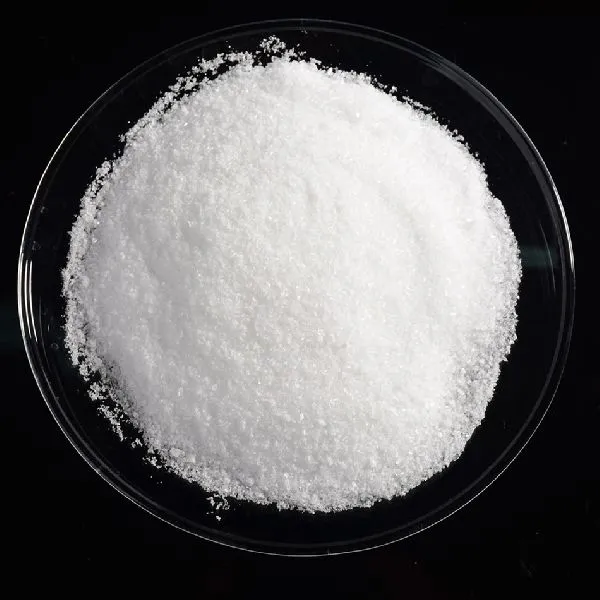

Balanced plant nutrition is one of the primary drivers of productivity, crop quality, and post-harvest shelf life. Among various fertilizer compounds, calcium nitrate in agriculture holds an irreplaceable position by supplying two vital elements—calcium and nitrogen—in readily available, plant-absorbable forms. This chemical compound exhibits exceptionally high water solubility, making it an optimal choice for drip irrigation (fertigation) and foliar spray systems.
Many agricultural soils, despite having adequate levels of total calcium, lack soluble and plant-available fractions. Under such circumstances, employing standard inorganic chemicals such as calcium nitrate prevents widespread physiological disorders across orchards and field crops. This article examines the functional roles, application methods, and economic and agronomic benefits of this fertilizer.
Chemical Structure and Properties of Calcium Nitrate
Calcium nitrate is an inorganic salt formed by the ionic bonding of calcium and nitrate ions. In commercial markets, it is supplied as highly hygroscopic white crystals or prills/granules. Rapid dissolution in water without leaving residues positions this product among the most widely used inorganic salts in industrial agriculture.
Unlike certain nitrogen carriers such as urea, which require microbial transformation in the soil to become plant-available, the nitrogen in calcium nitrate is entirely in the nitrate form. This feature allows immediate nitrogen uptake even at low root-zone temperatures. The simultaneous entry of the negatively charged nitrate anion and the positively charged calcium cation creates a synergistic uptake dynamic at the root interface.
The chemical formulation contains no harmful elements such as sodium or chloride, thereby minimizing soil salinization risks when applied under standard agronomic practices.
The Role of Calcium in Plant Growth and Physiology
Calcium is a fundamental structural constituent of plant cell walls and the middle lamella, primarily in the form of calcium pectate. It functions as an intercellular cement, imparting structural rigidity to stems, leaves, and fruit tissues. In the absence of adequate calcium, cell integrity collapses, sharply reducing the plant’s physical resistance to mechanical stress and environmental pressures.
Beyond its structural role, calcium functions as a secondary messenger in intracellular signaling pathways and stress-response mechanisms. The maintenance of cell membrane permeability, activation of enzymes involved in cell division, and osmoregulation all require a steady calcium supply. Because calcium is relatively phloem-immobile, it is transported almost exclusively through xylem vessels driven by the transpiration stream.
This vascular limitation causes calcium deficiency symptoms to manifest first in young, actively expanding tissues and low-transpiring organs such as developing fruits.
The Significance of the Nitrate Form in Crop Nutrition
Nitrate-nitrogen offers distinct nutritional advantages over ammoniacal nitrogen. Unlike ammonium, nitrate uptake consumes less metabolic energy from the root system and actively stimulates the uptake of essential cations such as potassium, magnesium, and calcium. This maintains an optimal ionic balance within both the soil solution and cellular sap.
Additionally, nitrate nutrition prevents excessive rhizosphere acidification, a critical factor in greenhouse production systems and coarse-textured soils. A balanced application of nitrates during critical vegetative stages ensures vigorous canopy development without contributing to excessive salt accumulation.
In targeted fertigation regimes, balancing calcium nitrate with other major nutrient sources—such as potassium nitrate—provides an integrated nutritional profile for high-yield production.
Advantages of Calcium Nitrate Application in Agriculture and Horticulture
The systematic deployment of calcium nitrate extends beyond mere deficiency correction; it serves as a management tool to meet commercial export and processing standards. Key qualitative and agronomic benefits include:
- Significant enhancement of fruit flesh firmness, reducing transit and handling damage
- Extended shelf life and reduced cold-storage breakdown
- Decreased susceptibility to fungal pathogens, such as Botrytis cinerea (gray mold), due to reinforced cell walls
- Heightened tolerance against thermal stress, drought conditions, and soil salinity
- Accelerated primary root initiation and dense root architecture development in seedlings and transplants
Preventing Physiological Disorders in Sensitive Crops
A primary objective of calcium nitrate application is the prevention of economically damaging physiological disorders. Blossom-end rot (BER) in tomatoes, bell peppers, and watermelons is directly linked to localized calcium transport deficiencies during rapid cell expansion. Routine fertigation or targeted foliar sprays effectively prevent this disorder.
In commercial fruit orchards, key disorders controlled by calcium management include bitter pit and superficial scald in apples, cork spot in pears, and tip-burn in leafy greens such as lettuce. In citrus and pistachio orchards, endocarp (shell) integrity and peel thickness depend closely on adequate calcium availability during early fruit set.
When irrigation fluctuations induce fruit splitting in citrus or pomegranates, calcium-rich cell walls provide greater structural elasticity, markedly reducing cull rates.
Methods and Application Timing of Calcium Nitrate
Application strategies depend on crop type, phenological stage, and substrate or soil physicochemical parameters. Calcium nitrate is fully functional via both soil fertigation and foliar application.
Fertigation and Root Feeding
In pressurized drip and micro-irrigation systems, calcium nitrate dissolves cleanly without clogging emitters. In closed or open hydroponic systems, it constitutes an indispensable component of the "A" stock tank. Incorporating this salt during early vegetative development and post-bloom fruit set maximizes marketable yields.
Fertigation events are most effective during peak daytime transpiration periods, ensuring the sap flow drives calcium directly to upper vegetative points and developing fruit clusters.
Foliar Spraying
Because calcium relocation from mature foliage to rapidly expanding sinks is minimal, foliar feeding supplies calcium directly onto fruit surfaces and growing tips. Foliar applications should be performed during cooler periods—ideally early morning or late afternoon—when stomata are open and evaporation rates are low to avoid foliar scorch.
Sequential foliar treatments, initiated at fruit set (e.g., walnut or hazelnut size) and continued until several weeks prior to harvest, maximize post-harvest flesh firmness and storage quality.
Key Compatibility and Mixing Considerations with Other Fertilizers
A critical aspect of fertilizer batching is preventing undesirable chemical reactions in stock tanks. The calcium cation ($Ca^{2+}$) has a strong chemical affinity for sulfate ($SO_4^{2-}$) and phosphate ($H_2PO_4^-$, $HPO_4^{2-}$) anions. Blending calcium nitrate directly with sulfate-bearing fertilizers precipitates insoluble calcium sulfate (gypsum), resulting in nutrient tie-up and blocked lines and filters.
- Never combine calcium nitrate with sulfate-based fertilizers in the same stock solution tank.
- Avoid co-dissolving with concentrated phosphate fertilizers, such as monoammonium phosphate (MAP), unless using isolated dual-tank systems (Tank A and Tank B).
- Tank mixing with standard iron chelates (e.g., Fe-EDDHA, Fe-DTPA) or compatible magnesium salts is acceptable at recommended dilution rates.
- Always conduct a benchtop jar test prior to high-volume tank blending to verify solution clarity and absence of precipitation.
Summary and Conclusion
Cell wall integrity and stable nitrate nutrition represent core pillars of modern commercial horticulture. The application of calcium nitrate offers a reliable method to mitigate calcium deficiency risks, eliminate physiological disorders, and deliver export-grade produce. Utilizing high-purity industrial-grade raw materials and adhering to correct injection and mixing protocols maximizes input efficiency and secures sustained agricultural returns.